
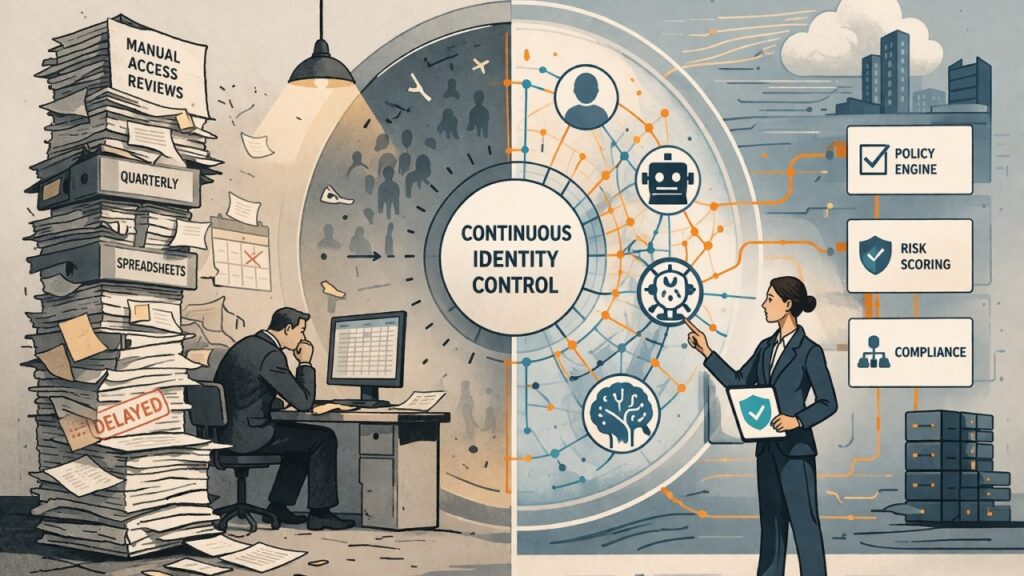
Identity governance is shifting from quarterly spreadsheet reviews to continuous, intelligent control. Three forces are driving this transformation: automation that eliminates manual bottlenecks, analytics that predict risk before it materializes, and continuous compliance that validates policy in real time.
The stakes are clear. Organizations now manage 112 SaaS applications on average, with enterprises exceeding 150. Machine identities outnumber humans 80:1, heading toward 144:1 by year end. Manual governance cannot scale to this complexity. The organizations modernizing now are replacing legacy platforms with AI driven systems that govern humans, machines, and autonomous agents from a single control plane.
Automation Eliminates the Manual Bottleneck
Nearly half of organizations identify manual workflows as the primary barrier to effective identity governance. The operational cost is measurable: IT teams spend hours managing spreadsheets, routing email approvals, and conducting repetitive access reviews that create delays and errors.
Modern platforms eliminate this friction across the identity lifecycle. When employees join, move, or exit, automated workflows synchronize access across directories, cloud applications, and hybrid infrastructure without manual tickets. Intelligent access requests evaluate policy, peer patterns, and risk scores before routing to approvers. Low risk requests matching peer profiles auto approve. Edge cases escalate with full context.
The efficiency gains are substantial. Modern identity governance platforms deliver 80 percent time savings in audit preparation compared to spreadsheet methods. Access review automation addresses approval fatigue by using machine learning to flag dormant permissions for removal, evaluate access against peer baselines, and pre validate low risk decisions. Reviewers focus exclusively on judgments requiring human expertise.
Analytics Transform Access Data into Predictive Intelligence
Organizations managing 150 applications across cloud and on premises infrastructure generate massive volumes of permission and usage data. Traditional governance relies on static rules and periodic sampling, missing patterns that emerge over time or across system boundaries.
AI driven analytics establish behavioral baselines for every identity by analyzing login records, access logs, and usage patterns. The systems learn normal behavior: which resources users access, authentication times, system interactions, and peer comparisons. With baselines established, AI monitors continuously for deviations signaling risk.
Anomaly detection operates in real time. An account requesting sensitive data at unexpected times or from unfamiliar locations triggers immediate alerts with contextual explanation. Security teams receive actionable intelligence rather than raw logs requiring interpretation.
Role mining solves one of identity governance’s hardest problems. Legacy platforms required manual role definition, creating bottlenecks as organizations grew. Modern platforms use machine learning to analyze existing entitlements and discover natural role patterns through deep learning, clustering, and natural language processing. Only 10 percent of organizations feel confident maintaining manual business roles. AI driven platforms reduce manual entitlement reviews by up to 75 percent through pattern recognition.
Predictive analytics forecast risk before it materializes. When evaluating access requests, AI predicts whether permission combinations breach segregation of duties policies. The system identifies toxic combinations like invoice creation plus payment execution and blocks changes before risk materializes. Peer analysis provides comparative context, showing managers whether similar users hold the same permissions to confirm fit or identify privilege creep.
Continuous Compliance Replaces Periodic Snapshots
Traditional compliance operates on quarterly or annual cycles. Organizations conduct reviews, generate reports for specific windows, and remediate findings in batch. This creates gaps. Access drift occurs continuously through project work, temporary assignments, and privilege creep. By the next certification cycle, actual risk posture may bear little resemblance to the last audit.
Continuous compliance shifts to real time governance. Modern platforms monitor access continuously, validating that permissions align with policy at all times. As users request access, systems evaluate against current policy, segregation of duties rules, and compliance frameworks instantly. Continuous monitoring tracks whether permissions are actually used. Dormant permissions trigger automated review or removal.
Compliance automation extends to evidence collection. Platforms maintain automated audit trails capturing every access decision, approval, modification, and remediation action. When audit requests arrive, systems generate evidence packages on demand with complete lineage. This eliminates months of manually reconstructing access history from disparate systems.
Regulatory frameworks now expect this capability. Compliance expectations around SOX, NIST CSF 2.0, and Zero Trust principles are tightening. The EU AI Act and evolving NIST and ISO standards expand requirements for how organizations authorize, monitor, and audit AI driven systems. Identity governance platforms are extending continuous compliance controls to cover machine identities and autonomous agents alongside human users.
The Non-Human Identity Challenge
The explosion of non-human identities represents identity governance’s most significant emerging challenge. Service accounts, API keys, automation bots, IoT devices, and AI agents vastly outnumber human users. Non-human identities already outnumber humans 50:1 or more in most organizations, with growth accelerating.
These identities often carry high level administrative permissions and operate unmonitored. Legacy platforms built for human employees ignore machine account risks. Research shows credential theft and over privileged account abuse remain top vectors for cloud breaches.
Addressing this requires unified governance managing human and machine identities across cloud, hybrid, and on premises environments in a single platform. Organizations need visibility into which service accounts exist, what permissions they hold, which systems they access, and whether permissions align with operational needs. Continuous monitoring must detect new identities and access drift in real time.
AI agents introduce additional complexity. Autonomous systems now act on delegated human authority, making decisions and accessing sensitive data at machine speed. According to the Cloud Security Alliance, 78 percent of organizations have yet to define policies for creating or decommissioning AI identities. Modern identity governance platforms extend controls to monitor both people and AI bots acting on their behalf, with clear accountability, audit trails, and containment playbooks.
Market Consolidation Reflects Strategic Imperative
The identity governance market is consolidating as major security vendors recognize identity as the foundation of security architecture. Palo Alto Networks acquired CyberArk for 25 billion dollars. ServiceNow bought Veza. CrowdStrike announced the SGNL acquisition. The message is clear: identity is no longer standalone but foundational to Zero Trust, cloud security, and threat detection.
For organizations, this creates pressure to move from fragmented point products toward unified platforms. The global identity governance market was valued at 9.29 billion dollars in 2025, projected to grow to 33.1 billion dollars by 2034 at 15.16 percent compound annual growth rate. This reflects enterprise recognition that effective identity governance reduces cybersecurity risk, enables regulatory compliance, and supports business agility.
The Modernization Path
Organizations on legacy platforms face critical decisions. Outdated systems built for on premises environments cannot scale to hybrid and multi-cloud complexity. They lack automation, analytics, and continuous compliance capabilities required for modern risk management.
Modernization requires evaluating three factors. First, automation depth. Platforms should eliminate manual spreadsheet workflows through intelligent provisioning, automated access reviews, and policy driven remediation. Second, analytics capabilities. Platforms must provide AI driven role mining, peer analysis, anomaly detection, and predictive risk scoring. Third, continuous compliance support. Real time policy enforcement, automated audit trails, and on demand evidence generation should replace periodic certification.
Cloud native platforms with extensive pre built connectors accelerate deployment. Organizations should prioritize platforms supporting both cloud and on premises systems, enabling phased migration. Proof of concept testing validates fit before commitment. Test with representative user populations, verify certification flows, and confirm AI recommendations align with business logic.
The Bottom Line
The future of identity governance transforms identity into a strategic control plane enabling business agility while managing risk. When governance operates through intelligent automation, organizations accelerate employee onboarding, support rapid cloud adoption, and enable DevOps velocity without sacrificing control. When analytics provide real time risk visibility, security teams shift from reactive incident response to proactive mitigation. When continuous compliance replaces periodic certification, organizations maintain audit readiness without operational disruption.
The technology exists today. Cloud native platforms, AI driven analytics, and continuous monitoring frameworks are production ready. Organizations face a choice: architect this transition strategically now or retrofit reactively after compliance failures and security incidents force change.
Identity governance is becoming a continuous, machine driven control layer underpinning Zero Trust, automation, and AI enabled workflows. Organizations that modernize platforms, extend governance to non-human identities, and implement continuous compliance position themselves to manage digital transformation securely. Those operating on legacy manual processes will find themselves unable to manage the risk, complexity, and regulatory expectations defining enterprise security.
The future runs on automation, analytics, and continuous compliance. The only choice is whether to lead the transition or be forced into it.
About the Author
Kimly Hong is a cybersecurity professional specializing in identity and access management, governance frameworks, and enterprise security program development. With hands-on experience implementing IAM solutions across complex regulated environments, Kimly works at the intersection of identity security, compliance, and business enablement. Connect on LinkedIn to continue the conversation about identity governance modernization.