
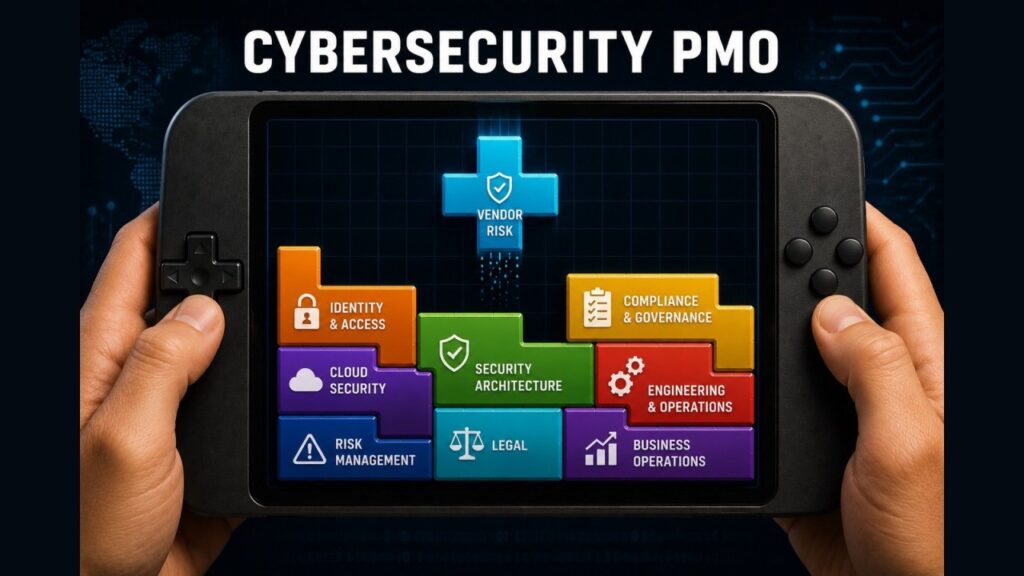
How The Security PMO Is Becoming the Operating System of Cybersecurity
The Security PMO has always been viewed as an administrative function responsible for project plans, status meetings, RAID logs, budgets, and executive presentations. That framing no longer fully captures what the function has become.
Modern cybersecurity programs span security architecture, engineering, cloud infrastructure, identity, governance, compliance, legal, procurement, vendors, and business operations. Each group may perform its own function well, but technical capability alone does not ensure that their work moves toward the same outcome. The modern Security PMO provides the operating structure that converts separate security initiatives into coordinated, accountable, and measurable enterprise outcomes, which is why it is becoming the operating system of cybersecurity.
An operating system does not perform every task itself. It allocates resources, manages priorities, coordinates processes, resolves conflicts, and ensures that independent components function together. The Security PMO serves the same purpose across cybersecurity by connecting strategy, technical delivery, governance, risk, and executive decision-making into one program.
Cybersecurity Has Become a Systems Problem
No major security initiative belongs to a single team, and the complexity of modern programs reflects that reality. A cloud security program may require architecture standards, engineering changes, identity controls, compliance validation, vendor coordination, financial approval, and executive sponsorship. An IAM modernization may involve application owners, infrastructure teams, security engineers, auditors, business leaders, and external providers, each of whom sees only the portion of the program directly in front of them.
Architecture defines the target state, engineering implements the technical changes, governance interprets requirements, business leaders assess operational impact, vendors deliver products and services, and executives decide whether unresolved risks are acceptable. Without a coordinating structure, these groups can move in different directions while still reporting that their individual tasks are on schedule. The Security PMO prevents that fragmentation by establishing one operating model for objectives, ownership, dependencies, decisions, risks, and communications.
Turning Security Strategy Into Executable Work
Security leadership often begins with broad objectives: improve cloud security, strengthen identity governance, reduce third-party exposure, modernize security architecture, improve regulatory readiness. Those objectives establish direction, but the Security PMO translates them into the defined workstreams, technical requirements, accountable owners, milestones, budgets, dependencies, and measurable outcomes that make execution possible.
That translation requires more than administrative project management. A security program manager must understand why the initiative matters to the business, what technical work must occur, which teams must participate, and what evidence will demonstrate that the objective has been achieved. Rather than replacing architecture or engineering expertise, the role creates the structure through which that expertise produces a coordinated result.
Managing Dependencies Before They Become Delays
Many cybersecurity delays begin with dependencies that were identified too late. A cloud control cannot be implemented until architecture approves the design. An application cannot adopt stronger authentication until an integration issue is resolved. A security platform cannot enter production until privacy, procurement, infrastructure, and operations complete their work. An audit issue cannot close until several control owners provide acceptable evidence, and these dependencies are often distributed across teams, tools, vendors, and management chains simultaneously.
The Security PMO makes them visible early by identifying the sequence of work, documenting decision ownership, establishing escalation paths, and preventing one team’s delay from remaining hidden until it affects the entire initiative. A project schedule shows when work is expected to occur, while a security operating model explains how that work depends on other decisions, systems, teams, and controls. The Security PMO maintains both and uses each to inform the other.
Creating Accountability Without Direct Authority
Security program managers frequently lead people who do not report to them. Architecture, engineering, cloud, identity, compliance, finance, procurement, and business teams may carry different priorities. Vendors operate under separate contracts and delivery models. Senior stakeholders may support the program while disagreeing about scope, cost, timing, or operational impact. The Security PMO creates accountability across those boundaries through clear goals, credible plans, defined responsibilities, transparent reporting, and disciplined follow-through, alongside the ongoing translation of technical issues into business consequences.
A delayed security dependency carries meaning beyond a missed milestone. It may create regulatory exposure, increase operational risk, affect a product launch, or leave a critical control incomplete. When leadership understands those consequences, escalation becomes more productive and decisions happen faster.
Communication as Part of the Control Environment
In cybersecurity, communication is a functional element of the control environment. Technical teams need precise information about requirements, implementation risks, dependencies, and decisions. Executives need concise information about exposure, progress, tradeoffs, and actions requiring intervention. Business stakeholders need to understand how security changes affect operations and what responsibilities they own. The Security PMO creates the communication structure for each audience through technical workstream reviews, risk discussions, executive dashboards, budget reporting, steering committees, and targeted escalation messages.
Effective executive reporting should answer: Which initiatives are at risk, and why? Which dependencies require leadership intervention? Where are scope, schedule, or budget pressures affecting the intended outcome? Which risks remain unresolved? What decisions are required now? Reporting serves those questions.
The goal is to support action, not to document that activity occurred.
Building Governance Into Delivery
When security standards, compliance requirements, evidence expectations, and approval criteria are introduced late in a security initiative, teams discover that a solution cannot be approved, audited, or operated as designed. The Security PMO prevents that outcome by integrating governance into the delivery model from the beginning, bringing appropriate stakeholders in early and defining where governance decisions occur.
For a cloud initiative, that may include architecture reviews, identity requirements, logging standards, data protection controls, and operational readiness criteria. For an engineering program, it may include secure design requirements, testing expectations, vulnerability remediation, and deployment approvals. For a compliance initiative, it may include control mapping, evidence requirements, ownership, and remediation deadlines. Integrating governance from the start prevents rework, missed requirements, and unresolved risk from accumulating until they cannot be resolved without significant delay.
Creating One Integrated View of the Program
Security functions often report through separate tools and cadences. Engineering tracks technical delivery, compliance tracks controls, audit tracks findings, risk teams maintain registers, finance monitors budgets, and vendors provide their own status reports. Each source may be accurate while the overall picture remains fragmented. The Security PMO creates the integrated view that security leadership needs: what is being delivered, which milestones are at risk, what dependencies remain unresolved, which risks require escalation, where spending is diverging from plan, and what outcome the organization will receive when the program is complete.
That visibility allows leaders to manage cybersecurity as one system rather than a collection of disconnected projects. It also supports more meaningful measures, since task completion alone says little about security value. Connecting execution to outcomes such as reduced exposure, stronger control coverage, faster remediation, improved authentication, greater resilience, or better audit readiness gives leadership a clearer view of what the program is actually producing.
Program Management Is Security Work
When executed well, program management is cybersecurity work: the mechanism through which security architecture becomes implemented capability, engineering stays aligned with governance requirements, cloud initiatives account for risk, and vendors, technical teams, business leaders, and executives remain connected to the same outcome. Firewalls protect networks, identity platforms protect access, engineers build technical controls, and governance teams define requirements and evaluate risk, but none of those functions independently synchronizes the enterprise security program.
The Security PMO is the coordination layer that performs that synthesis, turning cybersecurity strategy into operational reality and earning its place as the operating system of the enterprise security program.
About the Author
Kimly Hong is a cybersecurity professional specializing in identity and access management, governance frameworks, and enterprise security program development. With hands-on experience implementing IAM solutions across complex regulated environments, Kimly works at the intersection of identity security, compliance, and business enablement. Connect on LinkedIn to continue the conversation about identity governance modernization.