Most Tech GRC programs still operate like audit traffic control.
Evidence requests go out. Screenshots come back. Narratives get patched together. Remediation is tracked in spreadsheets. Everyone works harder as the audit gets closer.
That model can get a company through an assessment.
It does not scale in modern engineering environments.
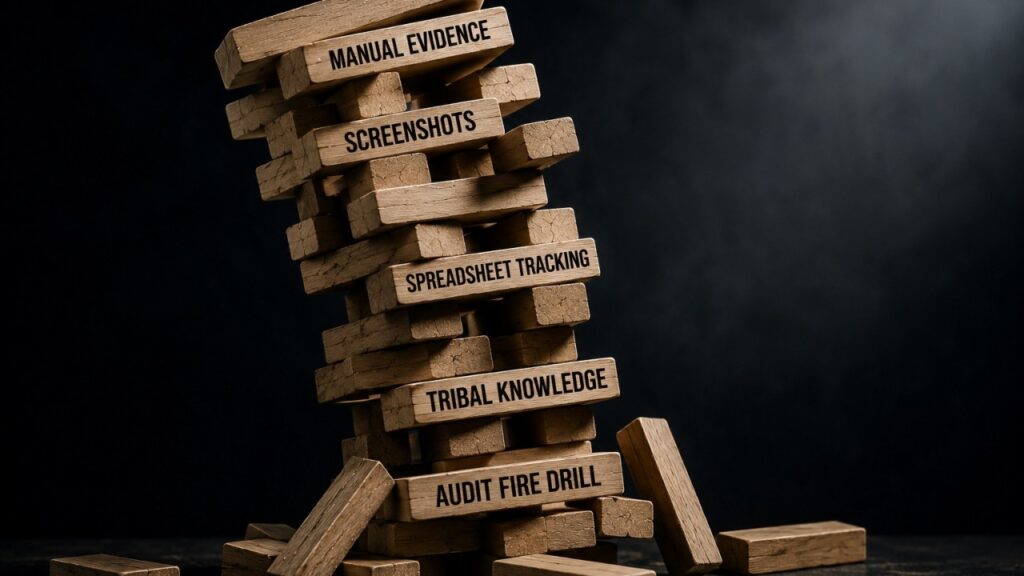
Worse, it often creates the illusion of control without the durability of control. On paper, everything looks stacked and stable. In reality, the program is being held together by manual evidence, tribal knowledge, point-in-time testing, and quarter-end heroics.
That is not a strong control environment.
That is a precarious one.
The best Tech GRC programs operate differently. They look much more like structural engineering than audit choreography. They build controls into systems. They automate evidence collection. They normalize requirements across frameworks. They treat audit readiness as a byproduct of operational design, not a quarterly reconstruction project.
That is the shift.
The old model was built for a slower world
Traditional audit coordination made more sense when infrastructure was more static, change moved more slowly, and evidence could be gathered without overwhelming the system.
That is not the environment most engineering organizations operate in now.
Cloud estates change constantly. Services multiply. Teams reorganize. Delivery pipelines accelerate. A control that depends on screenshots, tribal knowledge, and last-minute heroics becomes brittle very quickly.
A control narrative can sound solid in an audit room and still fail in production.
That is why so many programs look compliant on paper but fragile in practice.
The better model starts with a different question
The question is no longer, “How do we collect enough evidence to satisfy the audit?”
It is, “How do we design the environment so that good evidence falls out of normal operations?”
That is a systems question.
It is also why the strongest Tech GRC leaders increasingly look less like audit coordinators and more like builders. They still understand PCI, SOC, ISO, privacy reviews, and auditor expectations. But their real leverage comes from how controls are designed, enforced, measured, and surfaced across live engineering workflows.
What structurally sound Tech GRC looks like:
Controls implemented as system behavior, not just policy language
Identity boundaries, deployment approvals, logging requirements, and segregation of duties should be enforced through architecture, configuration, and workflow design wherever possible.
The goal is to make the right behavior the default behavior, not a documented expectation.
Evidence generated from systems of record, not collected after the fact
AWS Audit Manager is a direct example of this shift. AWS describes it as a service that automates evidence collection, reduces manual effort in collecting and organizing evidence, and continually audits AWS usage by collecting evidence from in-scope resources and services.
That is the point. Evidence generation becomes part of the operating environment. It is not a separate administrative exercise competing for engineering time.
Compliance boundaries embedded into workload design
Google Cloud’s Assured Workloads shows the same pattern from a different angle. Google describes it as a way to secure and configure sensitive workloads to support regulatory and sovereignty requirements, while Assured Workloads Monitoring provides visibility into compliance state and helps organizations spot violations, remediate them, and support auditor attestations.
Google also highlighted Deutsche Börse Group’s use of Audit Manager to detect resources that deviated from the control framework, such as resources set up outside approved regions, and to generate automated, auditable evidence for compliant Google Cloud usage.
That is not audit coordination. That is control design expressed through platform architecture.
Policy enforcement moved inside the delivery path, not beside it
GitLab’s deprecation of compliance pipelines in favor of pipeline execution policies is instructive. GitLab moved toward policy-based enforcement embedded directly into CI/CD, with enforcement happening inside the workflow rather than around it.
That is exactly where mature Tech GRC should be heading.
Not beside engineering. Inside the engineering path.
Framework requirements interpreted as design inputs, not paperwork outputs
PCI DSS v4.0’s customized approach is one of the clearest signals of where standards are going. The PCI Security Standards Council describes it as focusing on the objective of each requirement and allowing organizations to meet that objective through a defined method, rather than only one rigid implementation pattern.
FedRAMP 20x pushes in the same direction. Launched in March 2025, its redesign replaces traditional narrative-heavy submissions with machine-readable controls and continuous validation using Key Security Indicators. The first pilot authorization completed in approximately four months, compared to a 22-month legacy baseline. FedRAMP completed 144 total authorizations in FY2025, more than double fiscal year 2024.
When a major government authorization program redesigns itself around automated demonstration of secure configurations and practices, it is acknowledging something important: the old documentation-centric model is no longer well matched to the environments it is supposed to govern.
A cautionary example makes the point even more clearly
Okta’s 2023 support-system incident is a useful reminder that the real control surface is often larger than the formal production environment.
Okta disclosed unauthorized access to files in its support case management system and noted that HAR files can contain session tokens and cookies that can be abused to impersonate valid users. The incident affected 134 customers.
That is exactly the kind of event a structural engineering mindset is better positioned to catch.
Why? Because it treats support tooling, debug artifacts, access workflows, and environment segregation as real parts of the control environment, not administrative edge cases.
A coordination-only mindset often treats those as out of scope until they become incidents.
What this means for Tech GRC leaders
The best Tech GRC leaders should spend less time acting as evidence traffic managers and more time shaping the systems that make good evidence inevitable.
That means asking better questions:
- Can this control be enforced by architecture instead of training?
- Can this evidence be generated directly from a system of record?
- Can this framework requirement be mapped to a reusable technical pattern?
- Can this remediation stream be measured like an engineering program?
- Can this audit dependency be eliminated by building the right internal capability?
Those are not audit-coordination questions.
They are structural design questions.
They also create a very different relationship with engineering.
Engineers usually resist compliance when it arrives as ticket inflation, repetitive evidence requests, and controls that ignore how systems are actually built.
They respond much better when the program reduces ambiguity, minimizes interruption, and turns guardrails into part of the delivery system.
That is not just a cultural preference. It is a design quality issue.
A simple test
If your audit readiness depends on screenshots, tribal knowledge, and last-minute evidence marathons, you are still running a coordination model.
If your controls are reflected in IAM architecture, policy engines, CI/CD workflows, cloud configurations, monitoring, and continuously available evidence sources, you are moving toward a structurally sound model.
That is where modern Tech GRC needs to go.
Final thought
The future of Tech GRC is not fewer controls.
It is better control implementation.
The strongest programs look more like structural engineering because modern assurance depends on how systems are designed, how workflows are constrained, how evidence is generated, and how drift is detected.
Audit coordination still matters. It just should not be the center of gravity.
The center of gravity should be this: build controls that scale with engineering, generate evidence as a byproduct of operations, and make the environment easier to trust before an auditor ever asks the question.
That is what durable compliance looks like in a real technology company.
Kimly Hong is a cybersecurity professional specializing in identity and access management, governance frameworks, and enterprise security program development. With hands-on experience implementing IAM solutions across complex regulated environments, Kimly works at the intersection of identity security, compliance, and business enablement.
Connect on LinkedIn or www.kimlyhong.com to continue the conversation